
Texas’ Medicaid Managed Care Learning Collaborative: Origin, Contexts, and Key Takeaways from 2024 Efforts  

Episcopal Health Foundation (EHF) launched a partnership with key stakeholders more than six years ago to harness the capacity of MCOs in addressing non-medical needs of Medicaid members. The Learning Collaborative’s work has contributed to key legislation and policy changes that advance the NMDOH work of Medicaid MCOs to continually improve the health and well-being of their members.
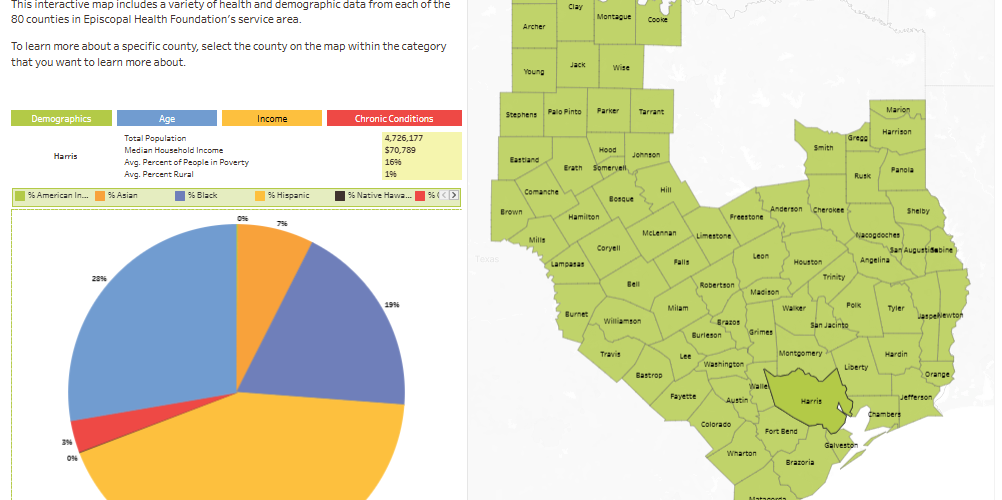
Understanding Community Health Through Data Mapping  

EHF’s research team has released an updated and improved County Health Snapshots data mapping tool. EHF’s County Health Snapshots (CHS) tool provides a peek into the important demographic factors and health outcomes within the EDOT.

Changing the Conversation

Impact of Episcopal Health Foundation’s Strategic Plan, 2018–2023 Key Findings: Episcopal Health Foundation has become a leader in improving health, not just health care in Texas with a commitment to health equity. The foundation has worked to change the conversation and shift the collective mindset → to focus on overall community health, in addition to … Read more

National Diabetes Month 2024: Insights from Recent EHF Learnings

Crosscutting themes surfaced from EHF’s learning and exploration of diabetes prevention interventions. Opportunities exist to increase screening to address health disparities in prediabetes and diabetes and for Texas Medicaid to explore funding models to include the CDC’s National Diabetes Prevention Program (DPP) as a reimbursable service with the intention to reduce diabetes among beneficiaries.

Report: Texas economy could save billions in losses by breaking the cycle of preventable health differences  

Preventable differences in health outcomes – which are closely linked to income, zip code, and race – are driving up health care costs and reducing work productivity across Texas, and the state’s economy is suffering more than $7 billion in annual losses because of it. For the first time, researchers estimate the local impact and county-level cost estimates of health disparities across the state.

Finer Points and Nuances of The Positive Deviance Approach

The foundation of the Positive Deviance approach is the belief that in every community, organization, or social system, there exist individuals or groups whose uncommon behaviors and practices have enabled them to succeed (relative to their peers) while facing the highest odds and with no extra resources. These individuals deviate from the norm (hence “deviance”) and have succeeded in overcoming the problem (hence “positive”). Because these individuals found success in spite of great odds represents social proof that local and sustainable solutions exist, and we may be able to learn from them.