
FORT WORTH, Texas – Episcopal Health Foundation (EHF) is joining researchers, health systems, community organizations, and city leaders across North Texas to launch a major new effort aimed at improving maternal health outcomes and reducing severe complications in pregnancy and childbirth.
EHF is the leading philanthropic investor in the North Texas Maternal Health Accelerator (MHA). MHA brings together the Anne Burnett Marion School of Medicine at Texas Christian University, the University of Texas Southwestern Medical Center, and more than 50 hospitals, clinics and community organizations. The effort focuses on reducing severe obstetric complications, strengthening maternal care coordination, and demonstrating how investments in maternal health can improve outcomes and reduce costs across the region.
EHF has invested $3 million to help launch the program and joins a long list of philanthropic funders supporting MHA.
“We are facing a maternal health crisis in Texas,” said Dr. Ann Barnes, EHF’s president and CEO. “But that’s about to change.”
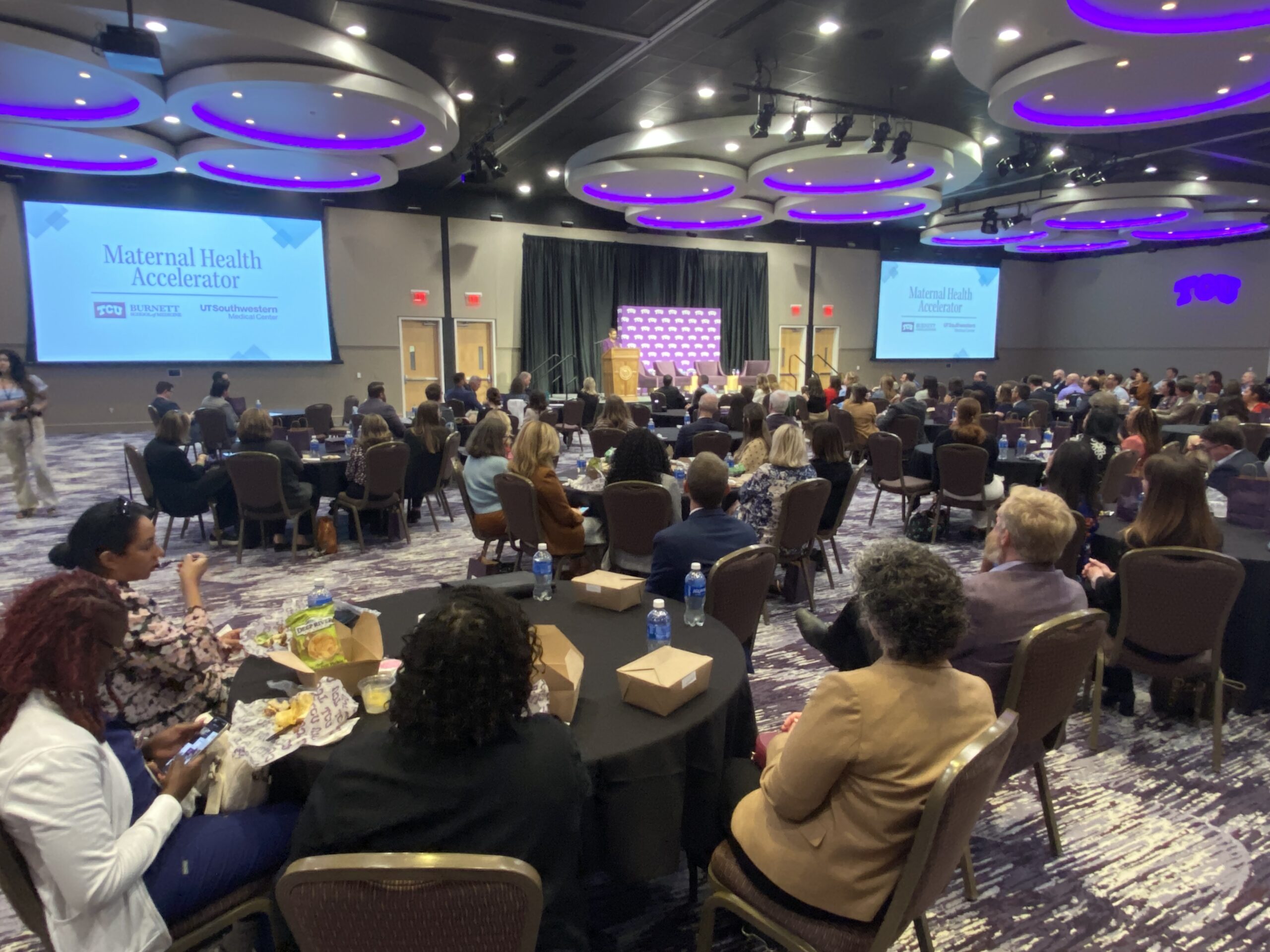
Barnes joined organizational leaders representing the groups driving the effort to offer remarks at MHA’s launch event at TCU. She emphasized that improving maternal outcomes requires more than clinical care. Meaningful change depends on breaking down barriers to factors like transportation, food security, child-care access and everyday stresses that shape health long before a medical emergency occurs.
“Because if a mother can’t get to her appointment or can’t afford to feed the family, that’s not a personal failure. It’s a systems failure,” Barnes said. “We’re changing systems and removing barriers to improve health, not just health care.”
Work already reaching families across North Texas
MHA’s first initiative targets postpartum hemorrhage, the region’s most common severe obstetric complication. More than 60 clinic sites across Tarrant and Dallas counties are distributing free prenatal iron supplements that research shows can reduce blood transfusion needs by about one third. Leaders say it demonstrates how simple interventions delivered consistently and equitably can dramatically improve outcomes.
“This is what happens when everyone pulls in the same direction,” said Dr. Stuart D. Flynn, Founding Dean of the Burnett School of Medicine at TCU and principal investigator for MHA. “We can save lives when we work together.”
Philanthropy stepped in when federal funding ended
MHA was originally developed as a nationally competitive, federally-matched pilot project. When federal priorities shifted and funding ended, EHF stepped forward to sustain momentum and expand the work.
At the same time, community organizations focused on health across Texas are facing shrinking budgets, delayed contracts, and rising demand. EHF is providing vital support to help them stay open and continue serving families.
A transformational gift from philanthropist MacKenzie Scott in 2022 strengthened EHF’s ability to fund those urgent needs while also supporting major long-term innovations. Scott’s $20 million unrestricted investment to EHF played a part in allowing the Foundation to take on innovative, yet-to-be-proven projects like MHA.

Supporting long-term sustainability and statewide replication
Along with the initial $3 million launch investment, EHF is committed to outcome-based payments that will reward measurable improvements in maternal health as MHA demonstrates progress. The foundation is also funding a financial return-on-investment analysis of the MHA model to quantify cost savings and support long-term policy adoption.
“We want to show how much money the model saves compared to what it costs, helping make the case for future state support to replicate it,” Barnes said.
A shared commitment to healthy mothers and healthy communities
MHA has galvanized broad support across philanthropy, health systems, government and community organizations, creating a unified approach to improving maternal health outcomes in Texas. The partnership aims to align resources, accelerate solutions, and strengthen the systems that support families. Barnes said meaningful change requires this aligned action and sustained collaboration.
“Healthy mothers mean healthy communities,” she said.